> For the complete documentation index, see [llms.txt](https://docs.neevcloud.com/llms.txt). Markdown versions of documentation pages are available by appending `.md` to page URLs; this page is available as [Markdown](https://docs.neevcloud.com/neevcloud-products/computes/launch-instance-by-1-click-marketplace-platform/create-a-fortigate-instance-from-the-neevcloud-marketplace.md).
# Create a FortiGate instance from the Neevcloud Marketplace
Fortigate is a Next-Generation Firewall (NGFW), that combines traditional firewall functions with additional features. It is a line of network security appliances developed by Fortinet.
## Create a FortiGate Instance
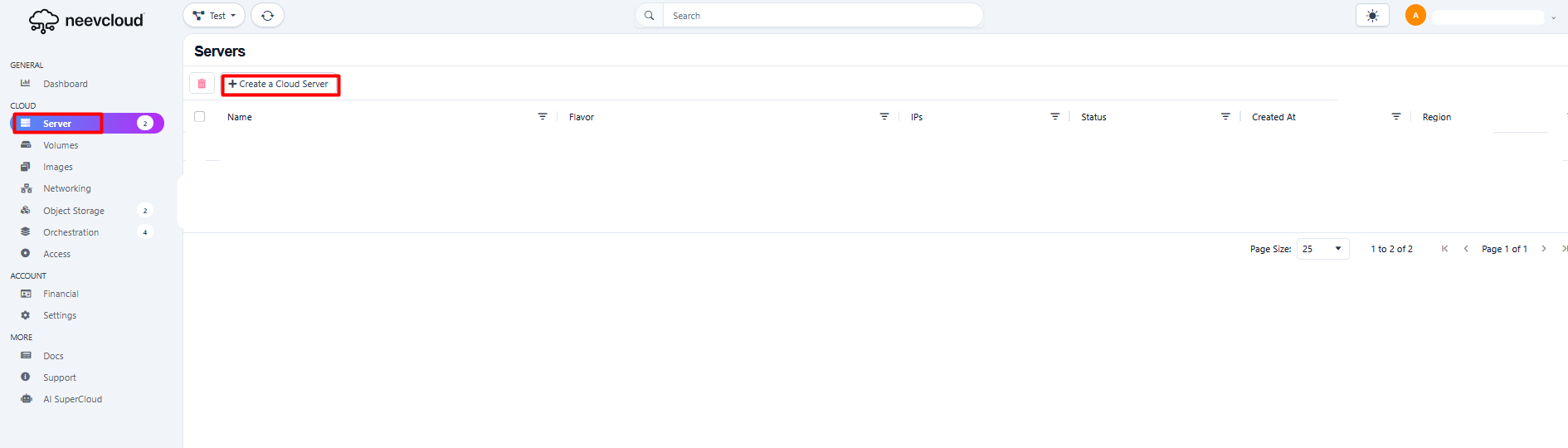
To Navigate to the neevcloud dashboard, select the server section and click on Create Cloud Server.
## Select Image
### Select the Marketplace
Navigate to the app, then choose the FortiGate version.
## Hardware Configuration
Users can choose different CPU and RAM configurations to personalize their system. General Purpose and Memory Optimized, CPU Optimized, GPU Enabled, and Smart Servers are the options that are offered. Click these [links ](https://docs.neevcloud.com/neevcloud-products/computes/getting-started-launch-vms#specifications)for further information.
## Select the volume
Choose the volume size which will be your root disk,
## Network configuration
* **Public Network:**- A public network is a type of network that is open and accessible to anyone, allowing users to connect freely. If you select a public network, you must configure it to allow public access to your server.
* **Private Network:-** A private network is accessible only to specific individuals or organizations, ensuring that the general public cannot connect to it. If you choose a private network, you must first create a Private network.
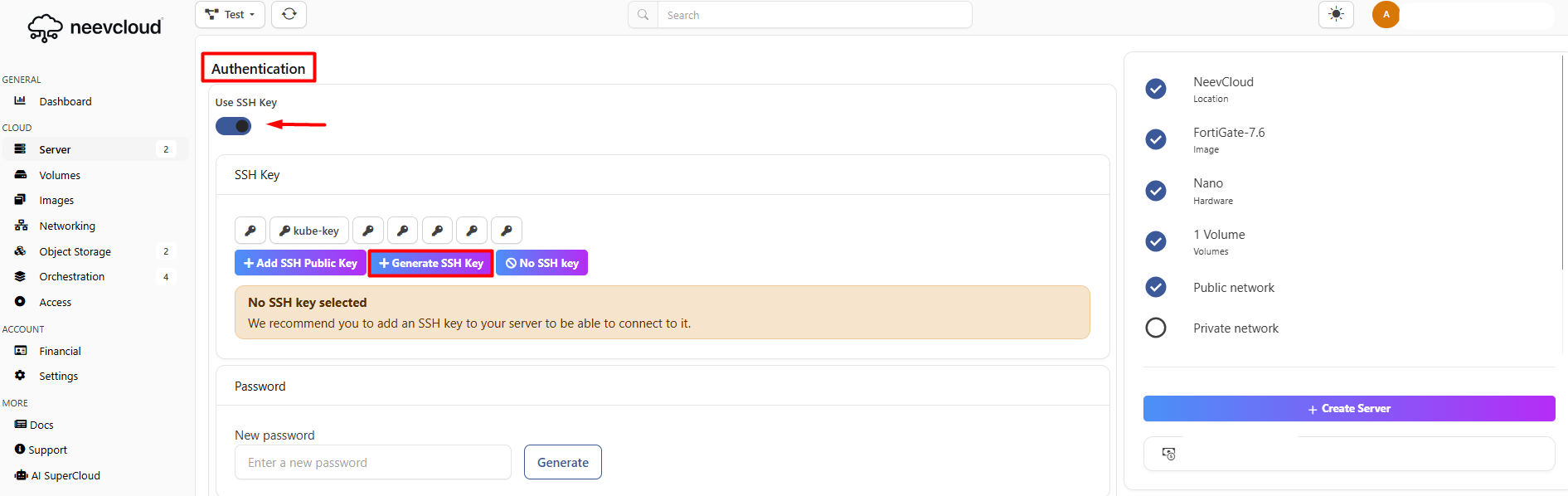
## Authentication
**SSH\_KEY:-** An SSH KEY is a source access credential used in the Secure Shell(SSH) protocol, consisting of a pair of public and private keys that authenticate users and establish encrypted communication between a client and a server. it would be best if you had to create an SSH key to access your server.
{% hint style="info" %}
Access to your server requires an SSH\_KEY. It is mandator
{% endhint %}
**Generating SSH KEY**
If you already have an SSH key, select it. If you don't have one, please follow this [link](https://docs.neevcloud.com/neevcloud-products/access-details/ssh-key) to generate an SSH key.
## Add Security Group
Click on Add Security Group. Ensure the required ports are allowed.
Enter the server name > Click 'Create Server'
Once your instance is created the status will change to Active, and other details will be shown.
## SSH
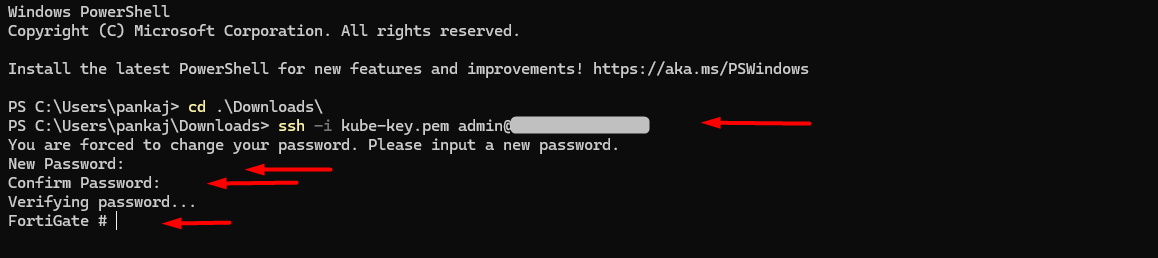
Now How to access the server follow these steps, First access the server via SSH using your SSH\_key, also, if you want to access it by using Putty follow these [links](https://docs.neevcloud.com/neevcloud-guide/neevcloud-knowledgebase/how-to-use-putty-for-ssh-key-based-authentication). Open the command prompt and navigate to the directory where you downloaded the SSH files.
{% hint style="info" %}
NOTE: if your SSH is not functioning, so you have to set the [permission](https://docs.neevcloud.com/neevcloud-products/computes/getting-started-launch-vms#permissions).
{% endhint %}
```
cd .\Downloads\
```
{% hint style="info" %}
To access the FortiGate, use the default username: `admin`
{% endhint %}
```
ssh -i your_ssh_key admin@your_server_IP_add
```
After running the command, a prompt will appear asking for a new password. Type your new password to continue.
Now open your browser and enter your public IP: `http://your-public-ip`
Now enter the username and password.
Let's see the Fortigate dashboard