> For the complete documentation index, see [llms.txt](https://docs.neevcloud.com/llms.txt). Markdown versions of documentation pages are available by appending `.md` to page URLs; this page is available as [Markdown](https://docs.neevcloud.com/neevcloud-products/gpu.md).
# GPU
## Deploy GPU Server
Click on the Create A Cloud Server button in the top right corner:
## Select Image
### Select the GPU OS
Click on the GPU OS and select the Ubuntu GPU
## Hardware Recommendation
It is mandatory to select the GPU-enabled option
## Select the volume
Choose the volume size which will be your root disk,
## Network configuration
* **Public Network:**- A public network is a type of network that is open and accessible to anyone, allowing users to connect freely. If you select a public network, you must configure it to allow public access to your server.
* **Private Network:-** A private network is accessible only to specific individuals or organizations, ensuring that the general public cannot connect to it. If you choose a private network, you must first create a Private network.
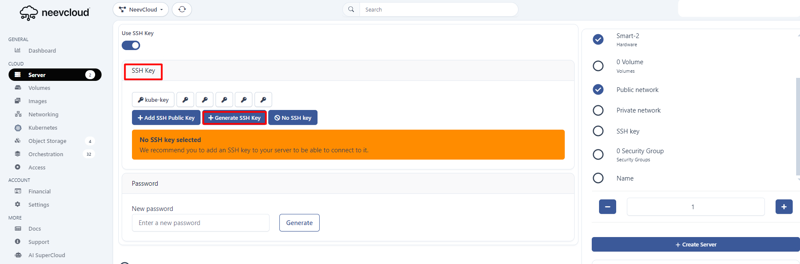
## Authentication
* **SSH\_KEY:-** An SSH KEY is a source access credential used in the Secure Shell(SSH) protocol, consisting of a pair of public and private keys that authenticate users and establish encrypted communication between a client and a server. it would be best if you had to create an SSH key to access your server.
{% hint style="info" %}
Access to your server requires an SSH\_KEY. It is mandatory
{% endhint %}
* **Password:-** A password is a secret string of characters used to verify a user's identity and grant access to a system or resource.
{% hint style="info" %}
To create a secure password with 10 characters, including symbols, Use a mix of uppercase and lowercase letters, Include numbers, and add special characters like `!`, `$`, `#`, etc. Avoid using easily guessable info like names or birthdates.
{% endhint %}
**Generating SSH KEY**
If you already have an SSH key, select it. If you don't have one, please follow this [link](https://docs.neevcloud.com/neevcloud-products/access-details/ssh-key) to generate an SSH key.
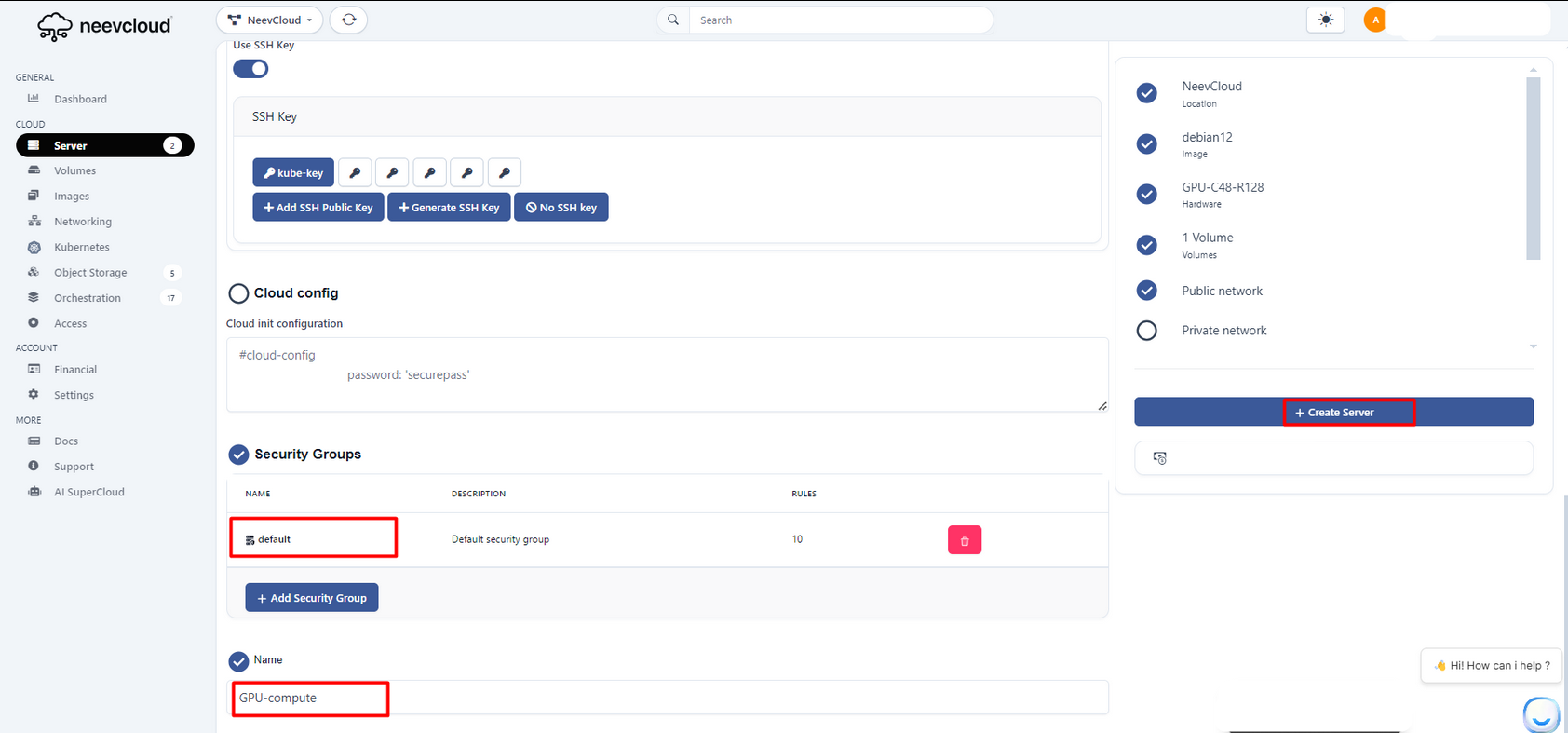
## Add Security Group
Click on Add Security Group.
Give the name of the server. Now Click the Create server
## SSH
First, access the server via SSH using your SSH\_key, also, if you want to access it by using Putty follow these [links](https://docs.neevcloud.com/neevcloud-guide/neevcloud-knowledgebase/how-to-use-putty-for-ssh-key-based-authentication). Open the command prompt and navigate to the directory where you downloaded the SSH files.
{% hint style="info" %}
NOTE: if your SSH is not functioning, so you have to set the [permission](https://docs.neevcloud.com/neevcloud-products/computes/getting-started-launch-vms#permissions).
{% endhint %}
```
cd .\Downloads\
```
```
ssh -i your_ssh_key username@your_server_IP_add
```
Now check the GPU on your server
```
sudo lspci | grep -i NVIDIA
```
After the driver is installed check the driver
```
sudo nvidia-smi
```